

United Keetoowah Band Council used electronic votes to authorize federal health and addiction funding requests in May 2026
By Staff Reports

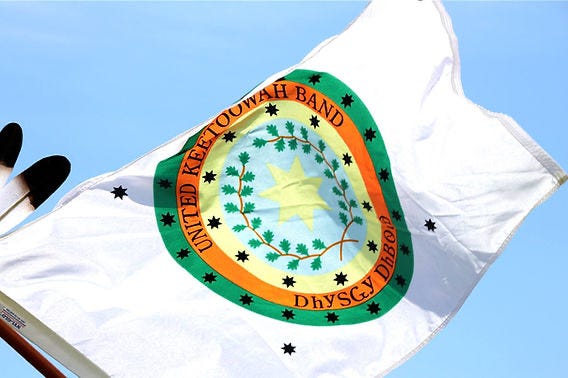
The United Keetoowah Band of Cherokee Indians in Oklahoma approved two federal grant applications through certified electronic votes this month, according to official tribal resolutions obtained by the Giduwa Cherokee News.
The resolutions involve potential funding for addiction treatment, jail-based reentry programs, behavioral health services, and health facility construction and repairs — programs serving Band members and other eligible American Indians across a fourteen-county service area on the Oklahoma Cherokee Reservation.
Here is what that means. When the UKB Council approves a federal grant application, it is giving the tribal government legal authority to ask the federal government for money. Without that approval, the application cannot move. The council’s signature is the proof the federal agency requires before it considers the request.
Both grants touch things people deal with directly. The first is money for addiction treatment and recovery — including people coming out of jail who need somewhere to go. The second is money to fix or expand a tribal health clinic. Across Indian Country, where the nearest specialist can be an hour’s drive from communities that still don’t have reliable broadband for a telehealth call, that building matters.
Both votes happened electronically. Twelve council members participated in each. Seven voted yes. None voted no. Four did not respond.
Resolution 26-UKB-54EV, dated May 11, 2026, authorized submission of a grant application to the U.S. Department of Justice Bureau of Justice Assistance under the Fiscal Year 2026 Comprehensive Opioid, Stimulant, and Substance Use Program. The proposed 36-month project would expand access to treatment, peer recovery services, naloxone distribution, prescription drug take-back programs, and jail-based reentry services, according to the resolution. Echota Behavioral Health and the Adair County Sheriff’s Office and Detention Center are named as partners.
A second resolution, 26-UKB-55EV, dated May 26, 2026, authorized the UKB Health Director to submit an application for the Indian Health Service Fiscal Year 2026 Capital Infrastructure Program Grant — renovation, expansion, and modernization of existing tribal health facilities. The Indian Health Service set a May 30, 2026 deadline for project proposals. The UKB resolution was certified four days before that deadline.
Both certifications use identical language. The UKB Council approved each measure “through an electronic vote,” according to the documents. Chief Jeff Wacoche signed both. Secretary Caleb Grimmett-Smith attested both.
Federal agencies receiving grant applications rely on certified tribal resolutions as proof that an authorized governing body approved the request. The DOJ Bureau of Justice Assistance and the Indian Health Service both require that documentation before processing an award.
No procedural document governing the UKB electronic voting system was included in the materials reviewed by the Giduwa Cherokee News. No rules for authentication, member notification, vote archiving, or records retention were produced.
The record does not show that governing procedures for the UKB electronic voting system have been made publicly available.
The UKB Constitution, ratified Oct. 3, 1950, sets seven council members as the quorum required to conduct business. According to the UKB Corporate Charter, approved by the Commissioner of Indian Affairs and the Assistant Secretary of the Interior, the council is charged with conducting the Band’s business and finance. Neither document addresses electronic voting procedures.