

The spring Candy Mink dug
By Troy Littledeer | @kituwahpunk


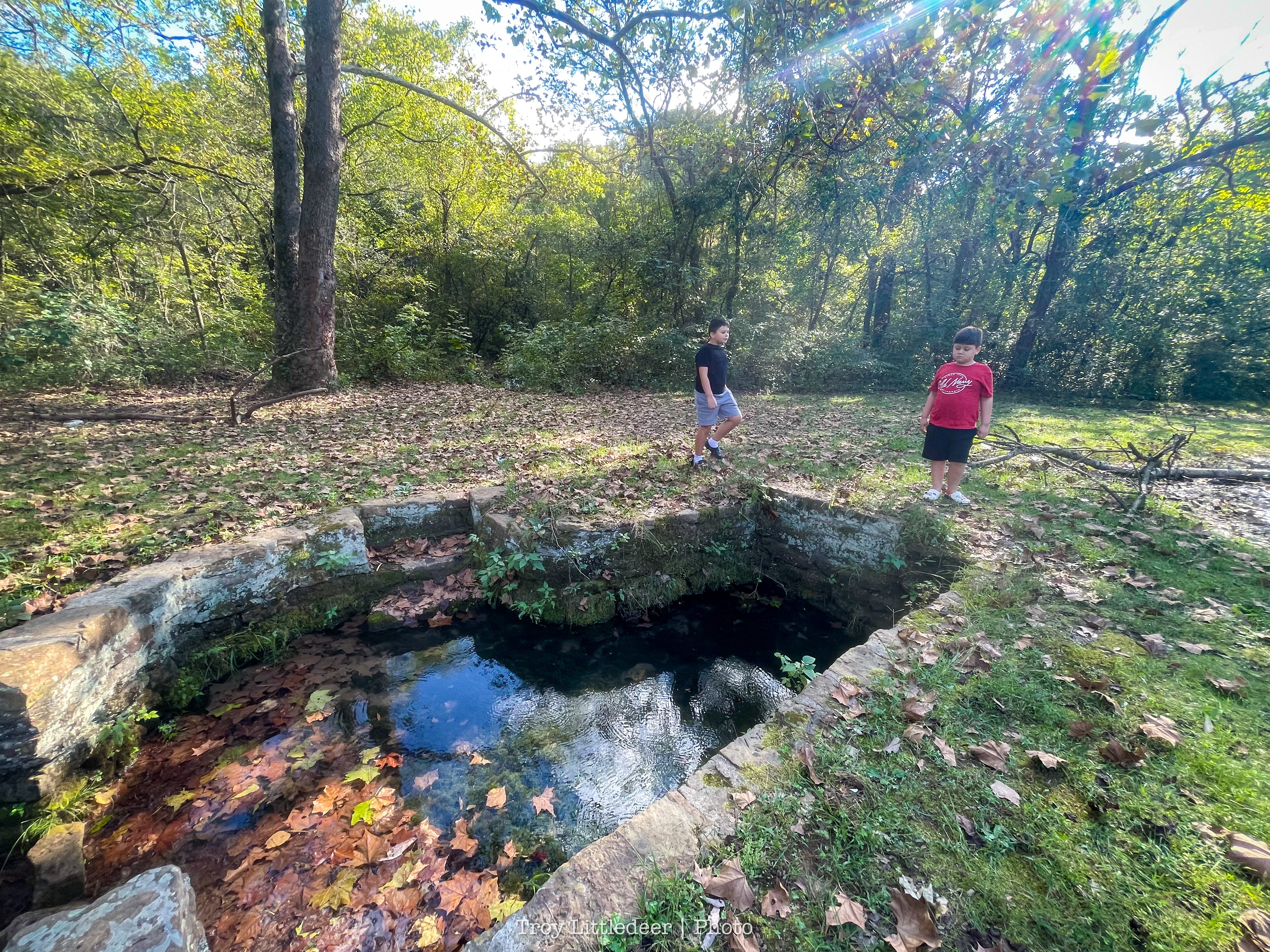
On Earth Day, I think about water.
Adair County, located in the heart of the Oklahoma Cherokee Reservation in northeastern Oklahoma, holds possibly the highest concentration of Cherokee people in the world. It is tucked with history the way old wood is tucked with rings — each layer a life, a family, a decision that echoed forward. The Candy Mink Springs community sits in the middle of it, nestled between the Cherry Tree, Bell and Greasy communities, modest in name but deep in memory.
The community is named for a man. Candy Mink came from Snowbird, North Carolina. Snowbird is a community in the mountains of Graham County, one of the places where Cherokee people held on during the forced removals of the 1830s — hiding in the hills, refusing to go, surviving by staying invisible to the soldiers sent to move them. Some Cherokee remained there permanently and became what is now the Eastern Band of Cherokee Indians. Others left later, on their own terms, or under different pressures.
Candy Mink left in 1880, part of a removal of 160 families or individuals who made the journey west to Indian Territory — what is now Oklahoma — decades after the main forced removal the Cherokee call “The Trail Where They Cried.”
The removal that began in 1838, when the U.S. Army rounded up Cherokee families at gunpoint, marched them through winter, and buried nearly 4,000 of them along the way.
Candy Mink was not on that march. But he came from the people who survived it, and he carried that survival with him when he and his sister Sally traveled together from the mountains of North Carolina to the flatlands and hills of eastern Oklahoma. They settled first in the Piney Community in the northern part of present-day Adair County. Someone pointed them toward Ross Mountain. That is where they stayed.
John Ross, a translator for the Cherokee Nation Language Department and great-nephew of Candy Mink, carries this history in his own blood. His great-grandmother was Sally Mink.
“Candy Mink stayed where the spring is,” Ross said. “He’s the one that dug the spring. That was what he used to draw his water.”
He dug it out of necessity. He needed water. He dug until he found it. That is the whole story, and it is also everything.
Candy Mink was known as a hard worker. He had a little money. He raced and bred horses. But what lasted — what put his name on the land and kept it there across generations — was a hole in the ground he dug so his family could drink.
My uncles and aunts walked to that spring for water and carried it home. My late father, Sequoyah, used to pull his ’69 Camaro over on the road to help neighbors haul their water back. My aunts and cousin gathered watercress with my grandmother from the creek the spring feeds into. I remember my entire family gigging crawdads in that same creek. I remember churches holding baptism ceremonies there — the water cold and clear, the moment solemn, the hills rising green behind the tree line, holding the whole place like cupped hands.
Then the Cherokee Nation built a landfill on top of those hills.
Not nearby. On top. The same hills the spring sits at the base of. Water moves the way it has always moved — down through rock and soil, carrying whatever it finds on the way. What goes on top of a hill does not stay on top of a hill. That is not politics. That is gravity.
The sky did not darken. No thunder. No sign. That is the cruelest part of this kind of damage — it arrives in the language of permits and planning documents, and by the time the smell reaches you the creek has already changed. The watercress is still there if you look. You do not eat it. The spring still runs. You do not drink from it. The creek still moves through the same land where my grandmother stood in rubber boots with a basket. The water still looks like water.
It is not the water it was.
On Earth Day, remember this. Not as history. As now. In Indian Country, these are resources that hold our communities together. They are not abstract. They are the spring Candy Mink dug. They are the creek that fed three generations of one family and the baptisms of a hundred more. They are the crawdads and the watercress and the cold water on a July afternoon and the stories that come after.
Protect them. Not because an occasion demands it. Because what we lose does not come back. Because Candy Mink is gone and the spring is still here and we owe him better than what we did to it.
By Troy Littledeer. Littledeer is an award-winning Indigenous journalist, photographer, and founder of Candy Mink Springs Media LLC and Kituwah Press, based in Stilwell, Adair County, Oklahoma. He is a United Keetoowah Band member and recipient of the 2025 Tim Giago Free Press Award. His work appears in Giduwa Cherokee News, NDNSports.com and Kituwah Punk.
 | A guest post by
|