

ᎩᏚᏩ: The Fire That Would Not Die
By Troy Littledeer


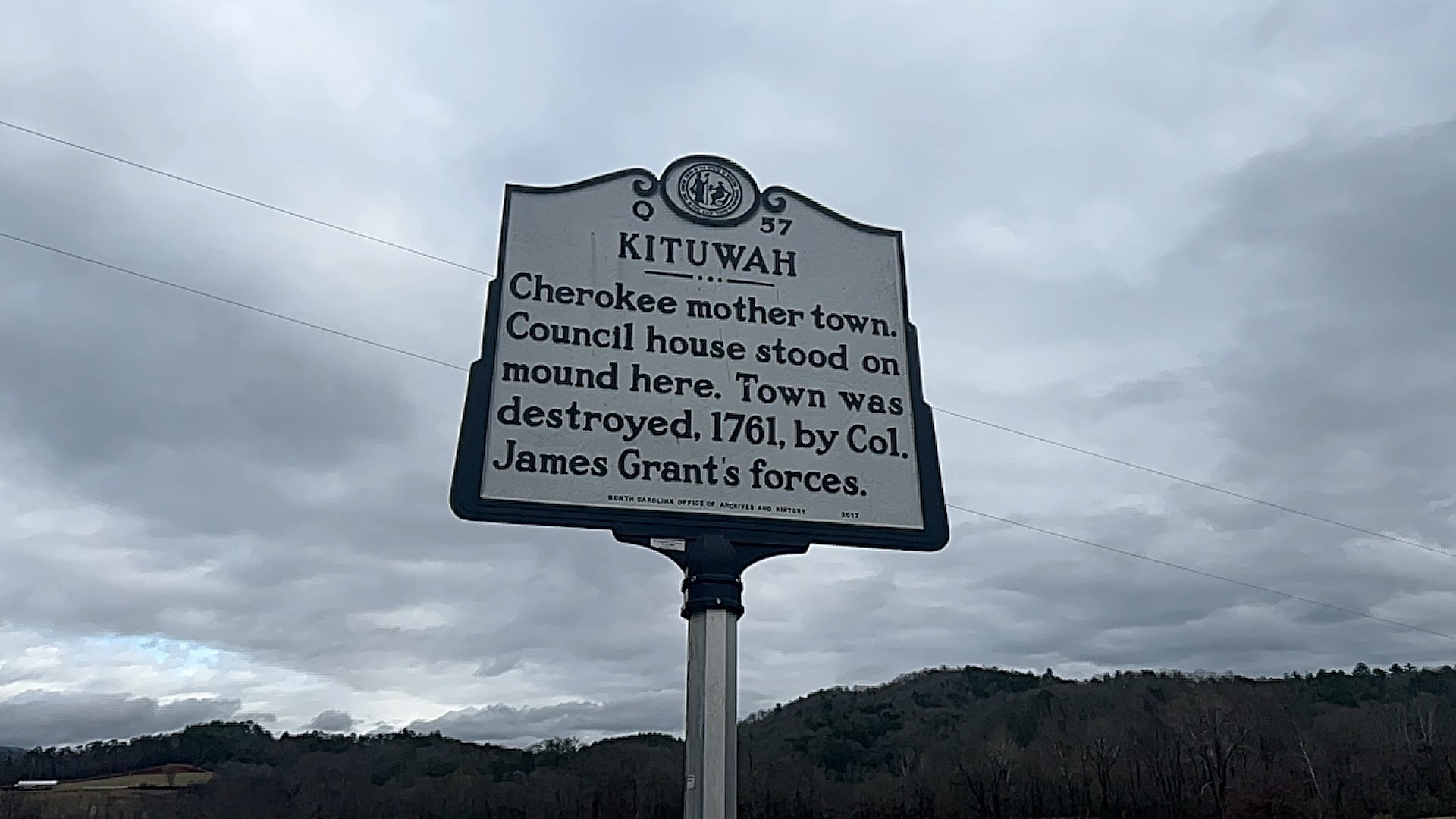
According to Keetoowah and Cherokee ceremonial tradition, the sacred fire never went out. It moved with the people.
That distinction matters. What is documented — in the archaeological record, in federal trust documents, in the 1900 ethnographic work of James Mooney, in the resolutions of two federally recognized tribal governments — is a tradition of ceremonial continuity stretching from a river bend in the Great Smoky Mountains to the stomp grounds of eastern Oklahoma. That continuity is the story.
The place is called ᎩᏚᏩ. The name traces to a root meaning to gather, the place where gathering happened. One of the seven mother towns of the Cherokee people, it sits in what is now Swain County, North Carolina, along the upper Tuckasegee River before its confluence with the Oconaluftee. Archaeologists date the earthwork platform mound there to roughly A.D. 1000, during the period of the South Appalachian Mississippian culture.
Mooney, whose fieldwork among the Cherokee ran from 1887 to 1890 and was published by the Bureau of American Ethnology in 1900, recorded how the mound was built: a circle of stones laid on the ground, a fire at the center, the bodies of prominent leaders placed near it along with objects of spiritual significance. A priest then conjured these with disease, protecting the town against any enemy who might destroy it. Women brought earth in baskets to raise the mound. At the center they fitted a hollow cedar trunk around the fire, tall enough to reach nearly to the surface of the finished mound. The townhouse was then built on top.
“One man, called the fire keeper, stayed always in the townhouse to feed and tend the fire,” Mooney wrote.
Just before the Green Corn dance, according to Mooney, every fire in the settlement was extinguished. The people came to the townhouse and received new fire from the sacred flame. “This was called atsi’la galunkw’ti’yu,” Mooney recorded — the honored or sacred fire. “Some say this everlasting fire was only in the larger mounds at Nikwasi, Kitu’hwa, and a few other towns, and that when the new fire was thus drawn up for the Green-corn dance it was distributed from them to the other settlements.”
Your hearth connected to the center. Every home in the nation tied to every other by a single living flame.
Mooney documented that the Cherokee on ceremonial occasions spoke of themselves as Ani-Kitu’hwagi — people of Kitu’hwa — and identified Kituwah as “apparently the original nucleus of the tribe.” The Ani-kitu-hwagi held the northern edge of the Cherokee homeland, standing between the heartland towns and Iroquois nations raiding from the north. Their name, and the place it came from, gradually became synonymous with Cherokee identity itself. Keetoowah. Giduwa. Every variation traces to that mound on the Tuckasegee.
The British burned Kituwah in 1761 during the Anglo-Cherokee War. Survivors dispersed westward. By 1819 the Cherokee had lost the Kituwah area through forced treaty cession to the United States. In the 1830s federal forces removed the majority of the Cherokee people west to Indian Territory on what became known as the Trail of Tears. European Americans took the land. They farmed the mound. By the end of the period of non-Cherokee ownership the site was within the boundaries of a private property called Ferguson’s Field. Archaeologists confirm the mound was plowed repeatedly.
Mooney recorded what Cherokee oral tradition held about that period: “The fire burns yet at the bottom of these great mounds, and when the Cherokee soldiers were camped near Kitu’hwa during the civil war they saw smoke still rising from the mound.”
In Indian Territory, Cherokee traditionalists who refused cultural dissolution formed the Keetoowah Society in 1858. According to scholarly accounts citing internal Keetoowah records, their meetings centered on the sacred fire, which members held had been brought west and kept burning. Redbird Smith led a ceremonial revival in the late 19th and early 20th centuries, establishing stomp grounds in eastern Oklahoma where the fire tradition continued. Today seven ceremonial grounds in Oklahoma operate within the Keetoowah tradition, according to the UKB John Hair Cultural Center and Keetoowah Museum in Tahlequah. Contemporary Keetoowah spiritual leaders have said publicly that if the old ways are discontinued, the Cherokee people will not physically cease to exist but will become indistinguishable from the non-Indian world.
The Eastern Band of Cherokee Indians purchased 309 acres on the Tuckasegee River, including the Kituwah mound, in 1996. A 1997 archaeological survey of the site recovered thousands of artifacts and identified evidence of thousands of years of human habitation. The survey also located 15 confirmed burials. Archaeologists noted the likelihood of substantially more, consistent with Cherokee custom of burying the dead in the village where they lived. The Eastern Band decided to leave the site undeveloped.
In October 2021 Principal Chief Richard Sneed signed an agreement conveying the Kituwah land into federal trust for the Eastern Band, establishing it as sovereign territory. The Bureau of Indian Affairs had already approved the request.
“Taking this land into trust will ensure this most sacred site will be preserved and honored in perpetuity,” Sneed said. “This land will never again be taken from our people.”
That same year, at a joint council meeting held at Kituwah, the Eastern Band and the United Keetoowah Band passed a resolution together recognizing their common link to the mother town and pledging to “forever be keepers of the Keetoowah tradition,” according to reporting by Smoky Mountain News. Relay runners had carried torches to the site lit from the eternal flame at the Mountainside Theatre in Cherokee, North Carolina — itself kindled 55 years earlier using coals carried from Oklahoma’s ceremonial fire.
The Keetoowah Museum in Tahlequah states that the Keetoowah people are held to be the most traditional of the Cherokee, perpetuating what it describes as the original sacred name of the people. All three federally recognized Cherokee tribes — the Cherokee Nation, the Eastern Band of Cherokee Indians, and the United Keetoowah Band of Cherokee Indians in Oklahoma — consider Kituwah the origin place of the Cherokee people.
ᎩᏚᏩ. The place where they gathered. Still gathering.
---
SOURCES
James Mooney, Myths of the Cherokee, Bureau of American Ethnology, 19th Annual Report, Government Printing Office, 1902. Full text: https://archive.org/stream/mythsofcherokee00moon/mythsofcherokee00moon_djvu.txt
Smoky Mountain News, “Anchored at Kituwah: After 138 years, Cherokee will reclaim its mother town as sovereign territory” (Jan. 12, 2022): https://smokymountainnews.com/archives/item/32585-anchored-at-kituwah-after-138-years-cherokee-will-reclaim-its-mother-town-as-sovereign-territory
Smoky Mountain News, “On Sacred Ground” (June 28, 2006): https://smokymountainnews.com/archives/item/13319-on-sacred-ground
Wikipedia, Kituwa, citing EBCI archaeological surveys and National Register of Historic Places listing 31Sw2 (1973): https://en.wikipedia.org/wiki/Kituwa
Wikipedia, Keetoowah Nighthawk Society: https://en.wikipedia.org/wiki/Keetoowah_Nighthawk_Society
UKB John Hair Cultural Center and Keetoowah Museum, Tahlequah, Oklahoma. YouTube Talking Circle (Dec. 4, 2023):
BPR Blue Ridge, Principal Chief Sneed statement (Sept. 6, 2023): https://www.bpr.org/bpr-news/2023-09-06/sneed-and-hicks-compete-for-principal-chief-of-eastern-band-of-cherokee
Oklahoma State Dept. of Education, United Keetoowah Band education guide: https://oklahoma.gov/content/dam/ok/en/osde/documents/services/american-indian-education/Tribes_of_OK_Education%20Guide_United_Keetoowah_Band_Cherokee.pdf
---
Troy Littledeer is an award-winning Indigenous journalist, photographer and member of the United Keetoowah Band of Cherokee Indians in Oklahoma. He has more than 20 years of experience covering tribal governments, Indigenous communities, education, sports and issues affecting Native nations. His work has appeared in publications including Osage News, Native Oklahoma Magazine, Cherokee Phoenix and NDNSports.com. In 2025, he received the Tim Giago Free Press Award from the Indigenous Journalists Association for defending tribal press freedom. ᎩᏚᏩ. To the center. Always.
 | A guest post by
|