

The Crimson Thread: Ralph Keen’s Journey from the Plains to the Schooner
By Troy Littledeer | @candyminksprings | Photo Troy Littledeer


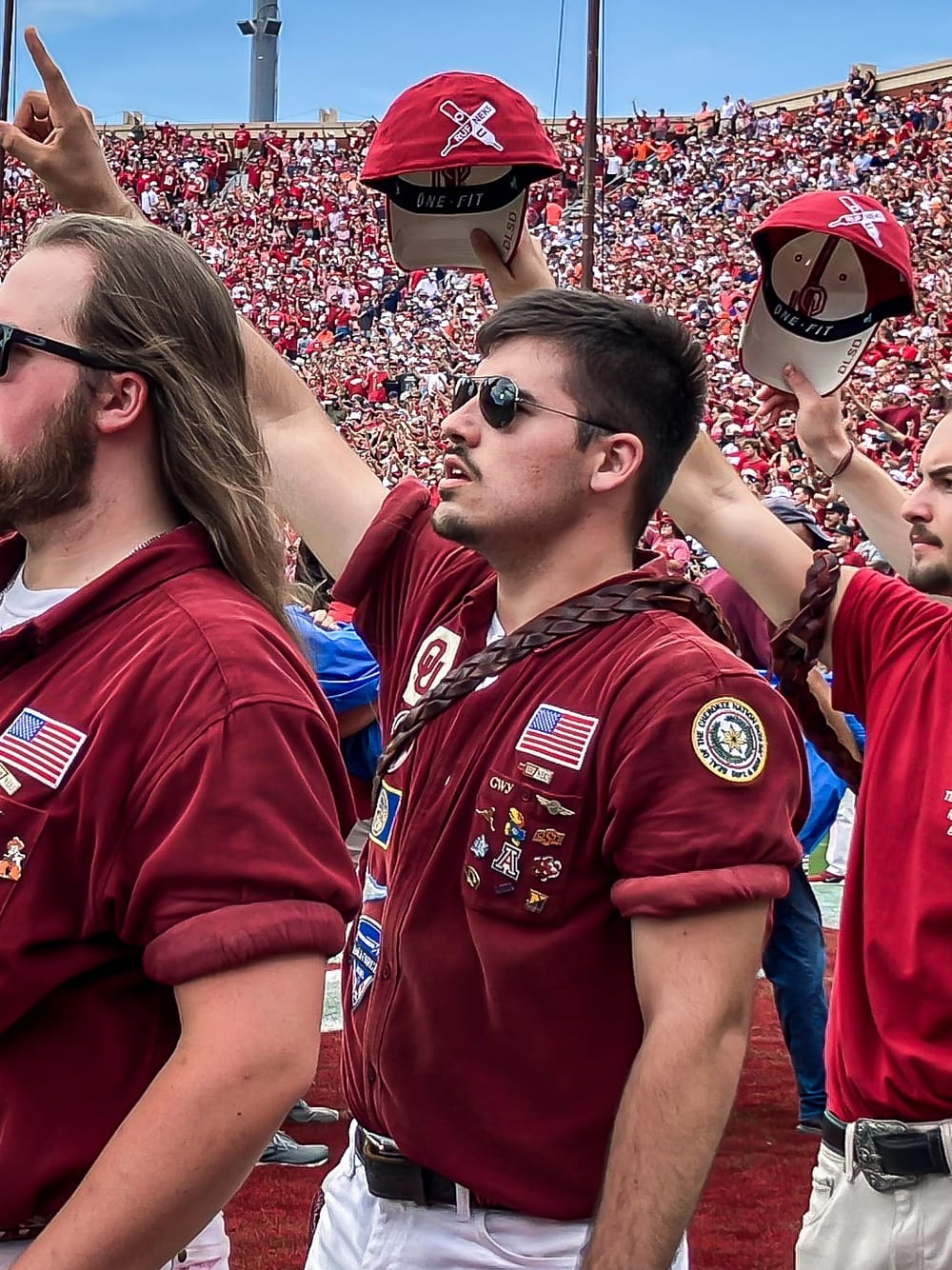
NORMAN, Okla. — The shotgun report comes a split second after the touchdown. It echoes across Gaylord Family–Oklahoma Memorial Stadium, swallowed almost immediately by 80,000 people rising to their feet. On the sideline, in the middle of one of college football’s oldest traditions, Ralph Keen resets, reloads, and turns back toward the field.
From the upper deck, he’s just another crimson blur in a 100-year-old routine. Up close, the Cherokee Nation seal on his shoulder breaks the pattern.
While 80,000 fans watch the scoreboard, Keen watches the timing on the field. A member of the OU Ruf/Neks — the university’s spirit squad responsible for driving the Sooner Schooner and firing shotguns after scores — he works inside a role built on precision. The group carries a visible piece of Oklahoma football tradition, moving in sync with moments the crowd expects.
The patch does something different.
It draws people in.
Families stop him before and after games — kids, parents, elders — recognizing something of their own in a place that has not always reflected them. Conversations start with the uniform, then move to where he’s from, who he represents, what it means to be there.
“They find pride in knowing that other Natives are doing what was once thought impossible,” he said.
Keen, a senior aviation major and Cherokee Nation citizen — part of one of the largest tribal nations in the United States, based in northeast Oklahoma — did not grow up in Oklahoma. He was raised in Elkhorn, Nebraska, in the middle of Big Ten country, far from the Cherokee Nation’s jurisdiction.
Distance, he said, never meant separation.
His family remained the center point. He traces his grounding to them — to the way they carried history forward without letting it hold them in place. He said relatives in Adair County, in the heart of the Cherokee Nation, who have served the tribal government for years helped shape his sense of responsibility to community.
“From our creation, we have always been forward-thinking,” Keen said. “When the times have gotten tough, we have always looked forward, staying resilient.”
As a freshman, he stepped into a program known publicly for its Saturdays. Internally, he said, the work extends beyond game day — into hospitals, food banks, and community service.
He found his place there. But he also found the limits of what people understand — and uses the classroom to address them.
As president of the OU Speech Team, Keen focuses on the Treaty of New Echota — the 1835 agreement that includes a provision for a Cherokee delegate to the U.S. Congress — and the Cherokee Nation’s ongoing effort to have that delegate seated.
“I wish people would take more time to understand how tribal nations operate as independent nations before making uninformed comments,” he said.
Now in his final year with the Ruf/Neks, Keen is preparing for a different path. He plans to enter the aviation field after graduation, shifting from the sideline to the cockpit.
The uniform will come off. The role will change.
What stays, he said, is the connection.
“I’m nothing without my Native community,” Keen said. “For everything, I’m forever grateful.”
On Saturdays, the stadium still shakes the same way. The Schooner still rolls. The shotguns still fire.
And on the left shoulder of a crimson uniform, the seal remains — visible, intentional, and carried into a space where it was not always expected to be seen, but where it has every right to be.
Troy Littledeer is a journalist and photographer based in Candy Mink Springs, Oklahoma. He is a member of the United Keetoowah Band of Cherokee Indians in Oklahoma and reports on tribal governance, education, and public accountability across Indian Country and surrounding communities. His work centers primary documents and recorded statements, with a focus on tribal law and the public record.
 | A guest post by
|
 | A guest post by
|