

The Constitution Says “All Members.” The Ordinance Changed It Later

The election law of the United Keetoowah Band of Cherokee Indians in Oklahoma still says the final voter list is due June 31. June has thirty days.
The same document calls itself the Election Ordinance of 2025 on page three and the Election Ordinance of 2022 four lines down. Section 408 opens at subsection (F), the first five letters gone. Section 906(A), the rule for election appeals, says “may appeal” twice before it reaches the period. Section 1001 says nothing shall be “constructed” to limit Council authority. The word is “construed.”
This is the document that decides who votes, who runs for office, how challenges get heard, and how appeals get filed.
The typos are the part you catch fast. They aren’t the part that matters most.
Here’s the part that matters most.
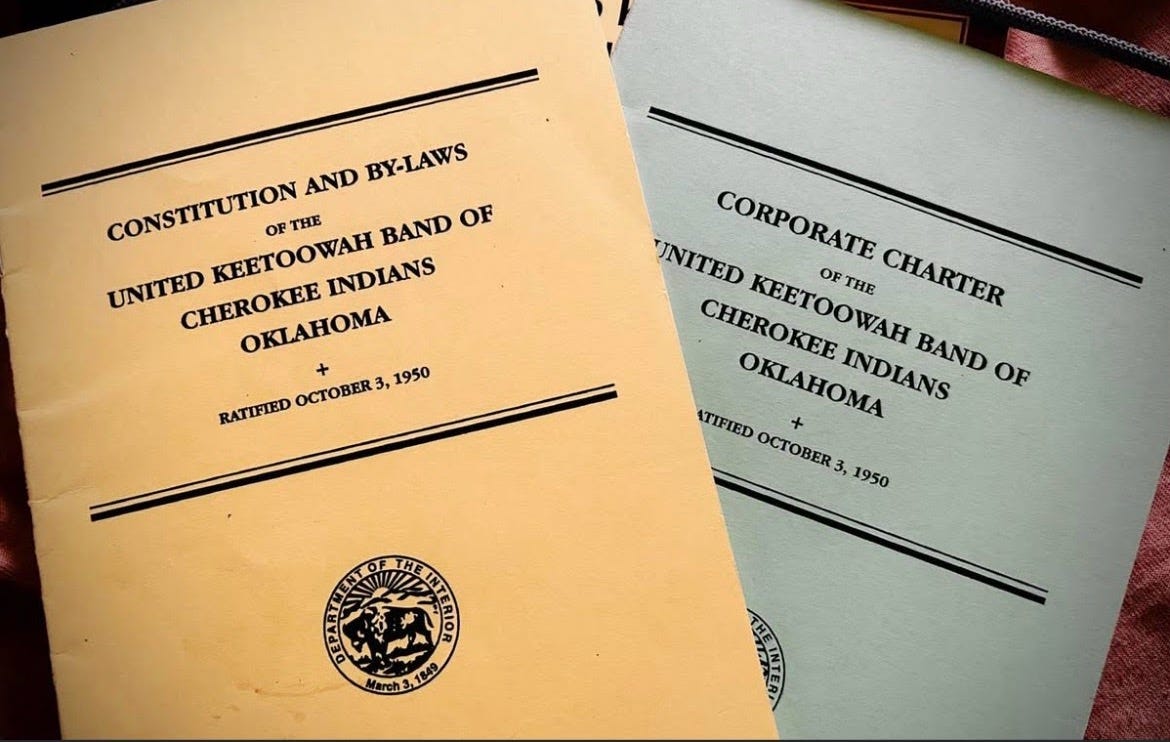
The Constitution of the United Keetoowah Band, Article VII, says it plain. “All members of the Band, twenty-one (21) years of age and over, shall be eligible to vote in any election.”
All members.
The ordinance says something narrower. To vote, Section 401 says you have to be an “Exclusive Member.” Section 104 defines that as a member who can prove one-quarter Cherokee blood and isn’t enrolled in any other Tribe or Band. Then it adds six months of exclusive membership before the election on top.
The Constitution’s voting clause names none of that. It says all members, 21 and over.
The ordinance points back to “the Constitution and By-laws” for its definition. That’s where this gets settled: whether one-quarter blood and no dual enrollment are what membership already means, or conditions the ordinance lays on the vote that the Constitution’s voting clause never wrote down. The Constitution says all members. Section 104 says prove a quarter. Both are sitting in writing.
It keeps going.
The Constitution calls the Council the “supreme governing body” of the Band, and says election rules are “prescribed by the Council.” The ordinance builds an Election Board it calls “independent and autonomous,” and in Section 211 lets that Board decide procedure on its own whenever the ordinance goes silent.
The Corporate Charter says the government exists “to define and safeguard the rights and powers of the United Keetoowah Band of Cherokee Indians in Oklahoma and its members.” Safeguard. That same government passed an election law that can’t hold June to thirty days.
The Constitution protects “freedom of worship, conscience, speech, press, assembly and association,” without hindrance. The ordinance, Section 104, makes campaigning “unlawful on tribally owned property,” carving out only private homes and the tribal newspaper.
You don’t have to be a Member to follow this. If a constitution said every member could vote, and a rule passed underneath it added a blood test and a paperwork test the constitution never mentioned, people would have questions. They should.
In a recent address to the Council, Chief Jeff Wacoche called the Constitution and the Corporate Charter the governing foundation of the Tribe. The election law built under that foundation still says June has thirty-one days.
The ordinance expects exact compliance from Members. Miss the address deadline by one minute and the ballot waits until after the election. The government that wrote the ordinance holds itself to a date that doesn’t exist.
The Constitution says all members. Section 401 says prove a quarter. The final voter list is due June 31.
Quotation and governing language drawn from the UKB Constitution, UKB Corporate Charter, and 2025 Election Ordinance of the United Keetoowah Band of Cherokee Indians in Oklahoma, including Article VII voting provisions, Article V Council authority provisions, Charter Section 1(a) (“To define and safeguard the rights and powers…”), and Election Ordinance Sections 101, 104, 201, 211, 401, 408, 906(A), and 1001, each confirmed against original document scans. UKB Chief Jeff Wacoche quotation and constitutional remarks drawn from his June 7, 2025 address to the UKB Council.