

Sound as sovereignty: Muscogee composer Aryn Ward builds a musical language from the inside out
By Troy Littledeer | @kituwahpunk


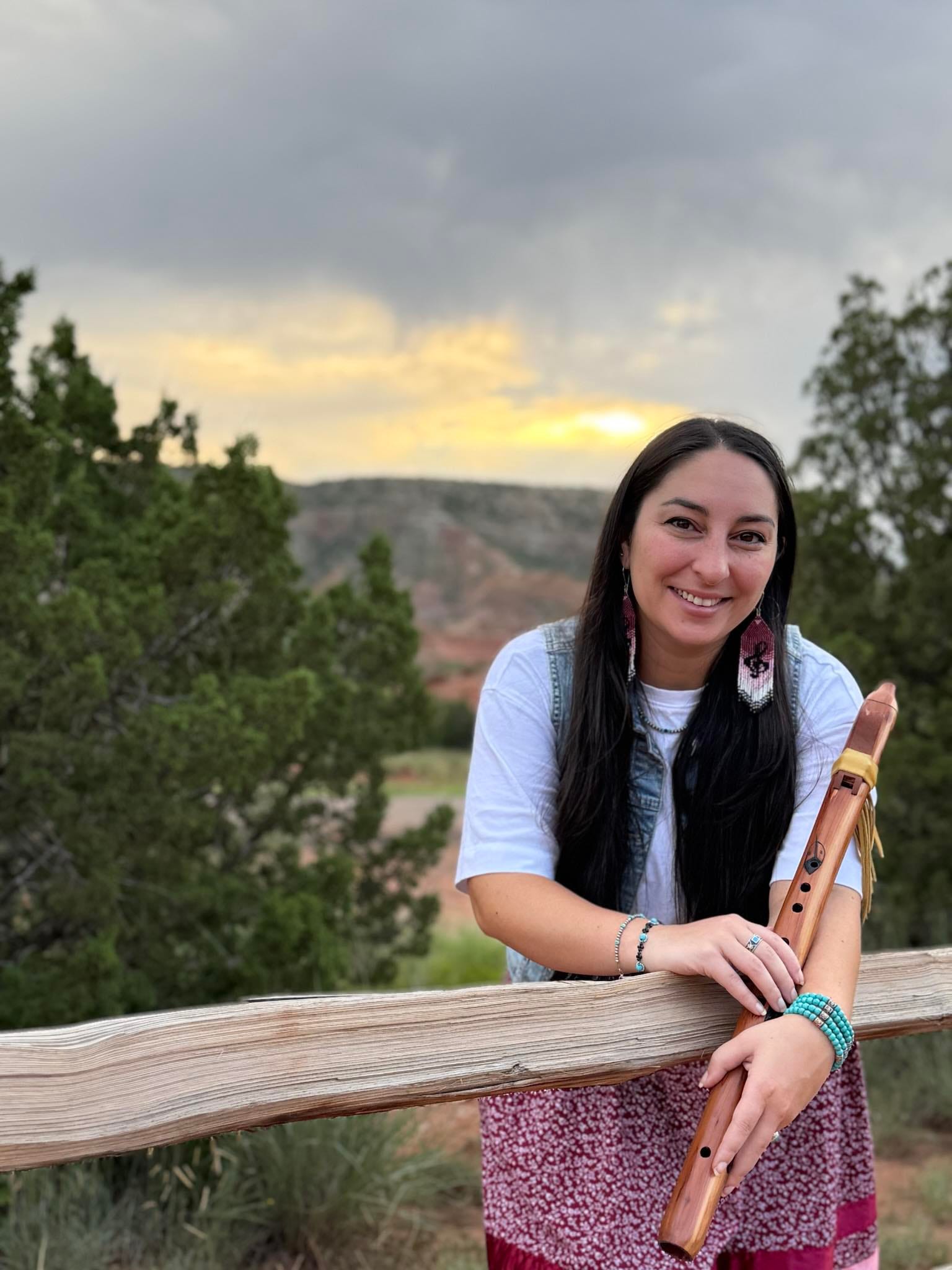
Aryn Ward started over in her 30s, and the music that came out the other side sounds like it was always there.
The Houston-based Muscogee artist is a flutist, composer, percussionist, photographer, and cultural coordinator who spent years away from music raising four children before her husband, a band director, pulled her back in. She taught herself multiple instruments before enrolling at Houston Christian University to study flute performance and music education formally. What she built from that return is a body of work that moves between classical rigor and Indigenous cultural preservation without treating either as a compromise.
“I play some really, really hard classical flute,” Ward said.
She performs with the Houston Concert Band and its flute ensemble. She has worked with Nameless Sound, a Houston-based experimental collective, leading children’s improvisation workshops and performing at avant-garde concerts. She has studied American Sign Language alongside wind, percussion, and electronic instruments. The range is not restlessness. It is method.
Her compositions often begin in dreams. Tafv Hotvlē — Muscogee for “feather wind” — premiered at a West Texas A&M Faculty Recital in July 2025. Scored for alto flute, bassoon, and harp, the piece moves between the power of an eagle in flight and the slow descent of a single feather. The opening harp entrance, Ward said, marks the exact moment the feather detaches.
The Mvskoke Months Suite does something quieter and more patient. Ward embeds the natural cadence of Muscogee words directly into classical melody — not as ornamentation, but as structure. In the movement “Tasahcuce,” meaning Little Spring or March, the rhythm of the Muscogee word becomes the rhythm of the music itself.
“It’s like hiding the natural rhythm of the language within the music,” Ward said.
The suite moves through the seasons — “Tasahce Rakko” for Big Spring, “Ke Hvse” for Mulberry Month, “Kvco Hvse” for Blackberry Month — each movement a documentation of cultural knowledge in a form that does not require explanation to be felt.
Ward describes music as spiritual in a way that most other things are not. During improvisation, an hour can pass in what feels like minutes. That is the space she is working toward — for herself and for whoever is listening.
“You can feel it deeper than just through your ears,” she said. “It’s not tied to time.”
When Tafv Hotvlē premiered, Ward listened from backstage as the piece she had carried inside herself came out of other people’s instruments. Faculty members told her it was calming. Friends told her it sounded like her — like how it feels to be around her.
“That was exactly the feeling I was going for,” Ward said. “I wanted my heart and my emotions to be out there, and that’s what happened.”
This November, Ward is organizing the Good Medicine Project, a music festival she describes as a platform to show the full range of what Indigenous music is and can be. The lineup includes White Mountain Apache violinist Laura Ortman and rock musician Sage Bond. Ward’s 13-year-old daughter will read her own poetry while Ward improvises live.
She credits composer Jerod Tate and curator Candice Hopkins for shaping her philosophy as a Native artist. Tate’s instruction to put your whole self out there and be unapologetic for who you are has stayed with her. Hopkins’ assertion that each piece of art screams its creator and demands to be heard sits alongside it.
“What you create, it needs to be who you are,” Ward said. “The more sincere you are about something, the better the product is gonna be.”
She is not chasing recognition. She is chasing improvement — a little better than the day before, compounded over time.
Ward’s compositions are available through her YouTube and Instagram channels at @mvskokemusicA dedicated website is forthcoming.
Selected works include Ohhvyvtketv (“All Night”), a cedar flute solo; River of Stars, a trio for flute, euphonium and trombone; and Nene Hvtke (“Peace Path”), a duet for flute and frame drum performed with her daughter Jaycie.
Troy Littledeer is a journalist and photographer based in Candy Mink Springs, Oklahoma. He is a member of the United Keetoowah Band of Cherokee Indians and reports on tribal governance, education, and public accountability across Indian Country and surrounding communities. His work centers primary documents and recorded statements, with a focus on tribal law and the public record.
 | A guest post by
|