

Roots run deep: Robinson carries Caddo, Choctaw identity into SEC spotlight
By Troy Littledeer | @candyminksprings


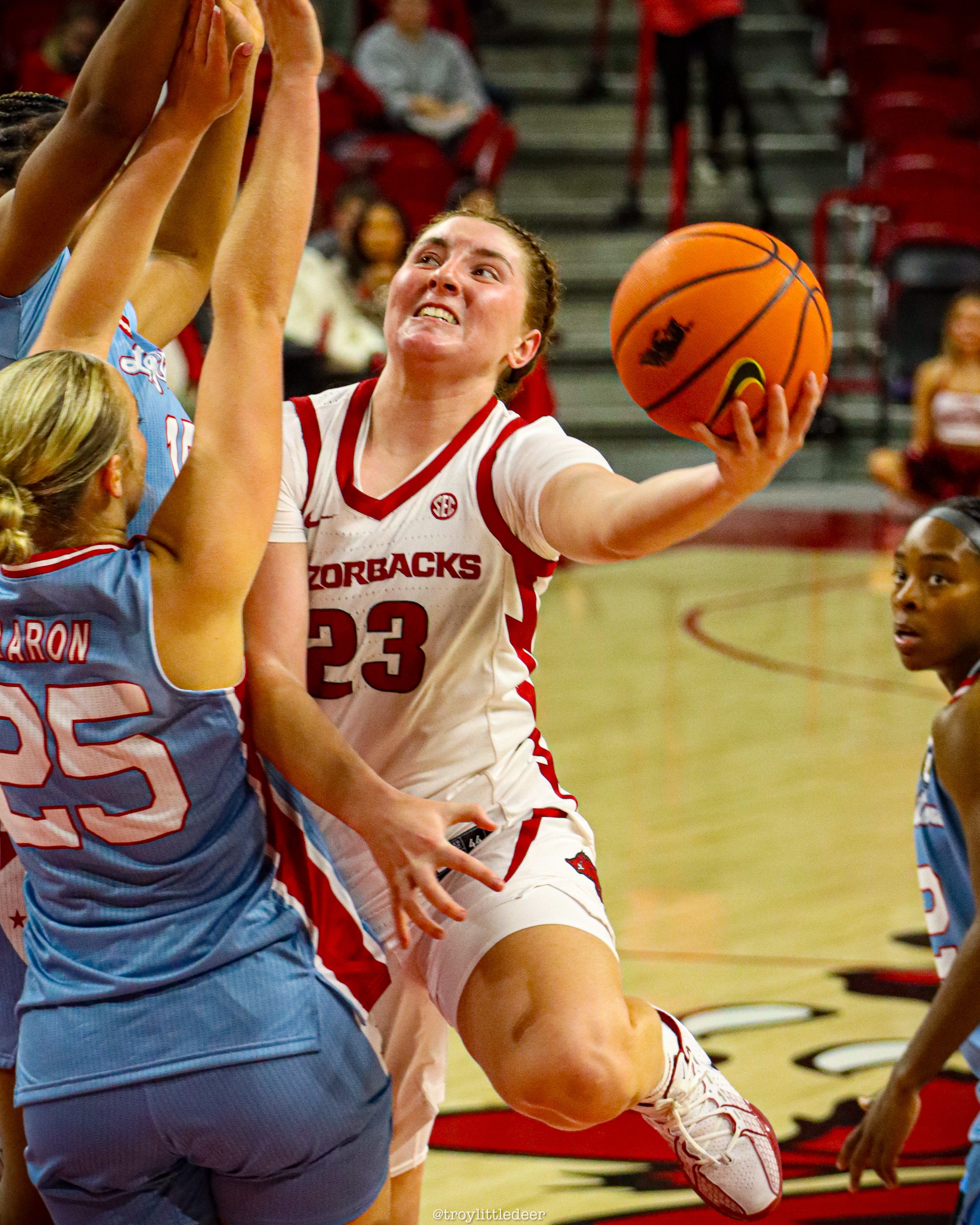
The road between Bokchito and Caddo, Oklahoma, is a fifteen-minute stretch of pavement connecting two towns where everyone knows everyone else. In Caddo, the high school graduating classes rarely break 40 students. The recognition is scarce.
The work is quiet.
It is a world away from Bud Walton Arena.
On Nov. 20, Emily Robinson, a daughter of that red dirt and a citizen of the Choctaw Nation, stepped onto the floor to lead the Arkansas Razorbacks against Little Rock on Native American Heritage Night. For the junior guard, the game was not just a contest of speed or skill. It was visible proof of a journey that began in tribal youth tournaments where she had to fight to be recognized as who she was.
Heritage, for Robinson, was never a question of blood. It was a fact of daily life. Her parents work for the Choctaw Nation — her mother in the health clinic, her father in tribal government. Her brother works at the headquarters in Durant.
But in the youth basketball circuit, identity was often judged by a glance.
Robinson grew up playing in all-Indian tournaments where rosters were regulated by citizenship, with the occasional exception for a non-Indigenous player allowed to fill a spot. With her fair skin and red hair, Robinson was frequently mistaken for the outsider.
“At first, I was a little embarrassed,” Robinson said. “People didn’t think I was Choctaw. I have the card to prove it. Just because I have red hair and I’m fairly white doesn’t mean that I can’t be part of Native Americans.”
That friction forged something. She learned to find pride in the truth rather than the perception.
“I still get all the benefits,” she said. “I’m very proud to be Choctaw.”
Robinson’s path to Division I basketball was not a straight line. After two seasons at Oral Roberts University, she faced a choice in the spring of 2025 when head coach Kelsi Musick accepted the Arkansas job. Robinson could have stayed in a mid-major program where she was established. She chose the discomfort of the unknown instead.
“I think every little girl’s dream is to play at the highest, biggest division,” Robinson said. “It might be a little uncomfortable at first, but there’s good in uncomfort.”
Through five games, Robinson was averaging 11.5 points and had become a stabilizer for a Razorback team still finding its identity. Against Central Arkansas on Nov. 10, she buried a game-tying 3-pointer with 12 seconds left to force overtime. Arkansas won.
The lights of the SEC are bright. Robinson’s vision stays fixed on where she came from.
She does not speak of WNBA rosters or overseas contracts. When her playing career ends, she intends to take her degree in sports management back toward Durant.
“Basketball has kind of consumed my life,” Robinson said. “That’s an option for me, is to always go back home and work for Choctaw.”
On Nov. 20 at Bud Walton Arena, the crowd saw a Division I guard battling for a win. Robinson was playing for something more durable — the small towns that raised her, the nation that claims her, and the red-haired girl in the tribal tournament who knew exactly who she was.
Troy Littledeer is a journalist and photographer based in Candy Mink Springs, Oklahoma. He is a member of the United Keetoowah Band of Cherokee Indians and reports on tribal governance, education, and public accountability across Indian Country and surrounding communities. His work centers primary documents and recorded statements, with a focus on tribal law and the public record. Troy also reports on real communities, sports and music.
 | A guest post by
|