

Op-ed: It’s not our fault we have three governments
By Troy Littledeer | @candyminksprings


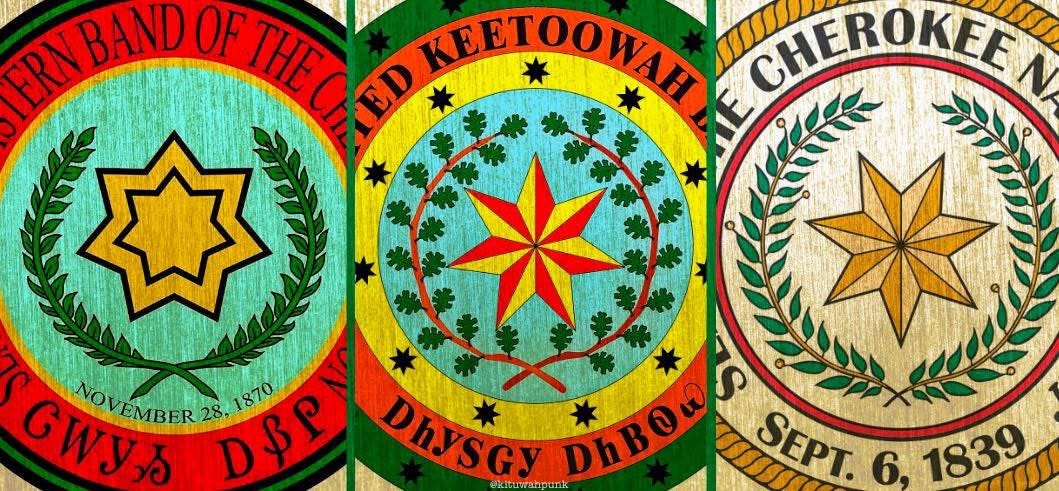
Here is something the Cherokee Nation would prefer you not think too hard about: the treaties that built their political argument also built ours.
The Treaty of Washington of 1846 secured lands “to the whole Cherokee people for their common use and benefit.” Not to one government. Not to the largest enrollment.
To the people. All of them. That language has been sitting in federal law for 179 years, and it still says what it says.
Three Cherokee governments exist today because Washington created them, not because Cherokee people asked for division. The Curtis Act of 1898 abolished tribal courts and imposed federal law on Indian Territory. The Five Tribes Act of 1906 curtailed tribal courts and legislatures while technically preserving tribal governments in a diminished form ahead of Oklahoma statehood. Then in 1946, Congress recognized the United Keetoowah Band of Cherokee Indians in Oklahoma for purposes of organizing under the Oklahoma Indian Welfare Act. By 1950, the UKB’s constitution had been ratified and approved by the Department of the Interior.
Federal decisions. Not Cherokee ones.
The Cherokee Nation has spent considerable energy arguing it alone inherits the treaties. Federal courts keep disagreeing. In 1998, UKB lobbyists placed a rider in a federal appropriations bill that took effect in 1999, changing the language governing trust land acquisitions within the original Cherokee territory in Oklahoma from consent to consultation — stripping the Cherokee Nation’s veto and replacing it with a notification requirement. The full citation is the Omnibus Consolidated and Emergency Supplemental Appropriations Act, 1999, Pub. L. No. 105-277, 112 Stat. 2681.
In 2019, the Tenth Circuit Court of Appeals upheld Interior’s authority to take land into trust for UKB despite the Cherokee Nation’s objections, in United Keetoowah Band of Cherokee Indians v. Cherokee Nation. The court held unanimously that the Cherokee Nation’s consent was not required before the Bureau of Indian Affairs could acquire the land. The U.S. Supreme Court declined to hear the case in 2020.
In 2017, a federal court in Washington, D.C., ruled in Cherokee Nation v. Nash that the Treaty of 1866 extended citizenship rights to Cherokee Freedmen descendants coextensive with native Cherokees — proof again that treaty obligations do not stop at the Cherokee Nation’s preferred boundaries.
Interior’s Solicitor issued M-Opinion M-37084 concluding that UKB is a successor in interest to the historic Cherokee Nation, that the Cherokee Nation does not hold exclusive control over the Cherokee Reservation, and that UKB has jurisdiction over its own trust lands. On Feb. 28, 2025, a subsequent Interior memorandum placed M-37084 under Suspension Review along with all M-opinions issued between Jan. 20, 2021 and Jan. 20, 2025. The opinion has not been reinstated, modified or revoked. During the suspension period, Interior units are directed not to rely on it as authoritative without consulting the Office of the Solicitor.
So the opinion is paused. The treaties are not.
The promises run to the people, not to whichever government has the most lawyers on retainer. If treaty fulfillment means anything at all, it has to reach every Cherokee descendant — UKB members, Cherokee Nation citizens, Eastern Band citizens — regardless of which government issued their card.
The United States made that promise to the whole Cherokee people. It does not get to outsource fulfillment to one government and call it done. Neither does the Cherokee Nation get to treat a shared inheritance as a private account.
Treaties are the supreme law of the land. That was true in 1846. It is still true now. The only thing that has changed is who is trying to use them as a wall instead of a foundation.
We did not ask for three governments. We got them anyway. What we are asking for — what the treaties actually require — is that all three be treated as what they are: governments of the same people, heirs to the same promise.
Troy Littledeer is a journalist and photographer based in Candy Mink Springs, Oklahoma. He is a member of the United Keetoowah Band of Cherokee Indians and reports on tribal governance, education, and public accountability across Indian Country and its surrounding communities. His work centers primary documents and recorded statements, with a focus on tribal law, the public record, and all people in our communities.
 | A guest post by
|