

Muscogee (Creek) Nation tables UKB resolution after Cherokee Nation pushes back
“Oppression is oppression, no matter the justification.” — UKB Chief Jeff Wacoche, Aug. 23, 2025 | By Troy Littledeer


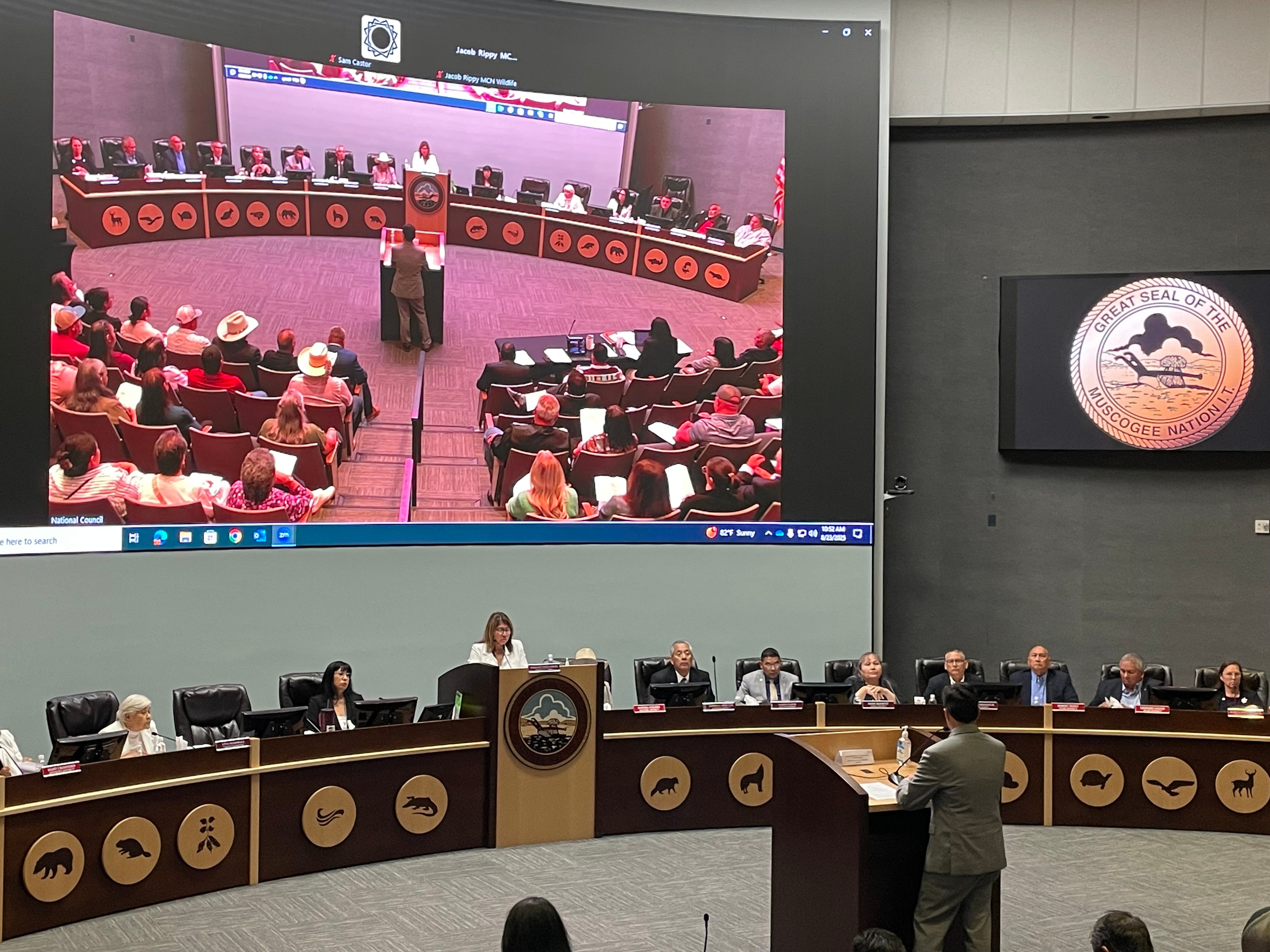
The Muscogee (Creek) Nation National Council voted Aug. 23 to postpone a resolution opposing proposed congressional language that would require Cherokee Nation consent before any other tribe could place land into trust within the Cherokee Reservation. The final vote was 9-4.
Nearly half the seating inside the Mound Building’s main chamber was filled by Cherokee Nation officials, including members of Principal Chief Chuck Hoskin Jr.’s cabinet, administration staff, and multiple executive directors. The United Keetoowah Band of Cherokee Indians council was also in attendance, joined by roughly a dozen UKB employees and a number of Keetoowah Cherokee People who traveled to Okmulgee to witness the discussion.
Cherokee Nation officials left the chamber immediately after the vote. The UKB delegation stayed.
The rider
The proposed language, authored by U.S. Sen. Markwayne Mullin, R-Okla., would bar the use of any federal funds to take land into trust within the Cherokee Nation Reservation without the Cherokee Nation’s written consent. It would further establish that no tribe other than the Cherokee Nation holds tribal jurisdiction over the reservation or any portion of it.
The UKB obtained the language through a Freedom of Information Act request and posted the documents on its website. The rider targets a Jan. 17 memorandum opinion issued by the Biden administration’s Department of Interior — M-37084 — which concluded that the UKB holds an ownership interest in the Cherokee Reservation as a successor-in-interest to the tribal signatory of the Treaty of 1846, holds exclusive tribal jurisdiction over its trust lands within the reservation, and that lands taken into trust for UKB for gaming purposes qualify as Indian lands under the Indian Gaming Regulatory Act.
The proposed language would direct Congress to halt the administration’s review of M-37084 and block any final agency action that follows from it.
The consent requirement Mullin’s language would impose is not new. Congress inserted a similar provision into a 1992 federal spending bill giving the Cherokee Nation effective veto power over UKB trust land applications. Congress removed that provision in 1999, replacing it with a consultation requirement — meaning the Cherokee Nation had to be notified but could no longer block UKB applications outright. The proposed rider would restore what the 1999 Congress took away.
The resolution
MCN Tribal Resolution 25-079 cleared the Muscogee (Creek) Nation’s Business, Finance, and Justice committee 3-0 on Aug. 14. Resolution sponsor Representative Dode Barnett and co-sponsor Representative Patrick Freeman Jr. brought it to the full council floor nine days later.
The resolution called on Congress to refrain from interfering, through appropriations or authorizing legislation, with the administration’s review of M-37084 and any final agency action that followed.
Barnett told the committee her push came partly from memory. Years earlier, the Muscogee (Creek) Nation sought allies when fighting to protect Hickory Ground in Wetumka, Alabama, and found few tribes willing to stand with them.
“I didn’t want Keetoowah to be alone in this battle as well,” Barnett said.
On the full council floor, she pressed the broader point — that the method mattered as much as the outcome.
“The irony of the remarks made here today about this happening without consultation is not lost on me, because that’s what’s happening at the federal level,” Barnett said. “It doesn’t feel good when it’s happening to you, and that’s the bigger point.”
The arguments
Hoskin told the council the resolution would damage a relationship he described as foundational to his obligations as principal chief.
“If this is approved, the Muscogee Nation National Council is entering into the debate in a way that will do irreparable damage to something that I hold as dear as Principal Chief, as treaties that I must uphold, the Constitution that I must uphold, and that is the relationship and the friendship between the Muscogee Nation and the Cherokee Nation,” Hoskin said.
He framed the vote as a choice between neutrality and condemnation.
“This is not about process and consultation,” Hoskin said. “This is about condemnation. Make no mistake — the question before you is whether to condemn the Cherokee Nation for doing what any nation would do to protect its sovereignty.”
UKB Chief Jeff Wacoche told the council the language was inserted without the UKB’s knowledge and would cut off the tribe’s ability to develop housing, healthcare, and economic infrastructure for its members.
“The proposed legislative language is intended to steal, in secret and without consultation with the UKB, our rights as a sovereign,” Wacoche said. “At its core, it is a blatant attack on our sovereignty.”
He told the council the congressional language was also designed to prevent the UKB from having its day in court — blocking judicial review of the underlying treaty and jurisdiction questions M-37084 addressed.
Wacoche drew applause from the chamber when he said: “Oppression is oppression, no matter the justification.”
The vote
Representative Sandra Golden voted to postpone in the full session despite voting to pass the resolution in the BFJ committee two weeks earlier. She said she wanted language that was, in her words, “inclusive, that unites us all rather than picking.”
Representative Robert Hufft said the matter should not have come before the council at all.
“No matter how we make a decision, we’ll be seen as favoring one side or the other,” Hufft said.
Council Member Anna Marshall moved to postpone indefinitely. Council Member Nelson Harjo Sr. seconded. The motion carried 9-4.
Voting against postponement: Barnett, Freeman, Representative Mark Randolph, and Representative Robyn Whitecloud.
The resolution can be reconsidered. No date has been set.
Mullin’s office did not respond to a request for comment.
 | A guest post by
|