

He Kept Driving
“My children almost lost their father that night. But what they did lose was so much of their childhood.”

Commentary by Taylor Thomas
On December 14, 2015, I was a 23-year-old mother of four children, married to a Westville police officer. Our children were six, five, and three years old. Our daughter had celebrated her first birthday that September.
People often say terrible things don’t happen in small towns like Westville, Oklahoma. Whenever I hear that, I correct them.
That night ended with my husband nearly killed during a police chase in Adair County. The event is documented in court records and continues to shape our family’s life more than a decade later. It is one I still measure against the silence that followed from people who knew us.
That evening didn’t begin any differently than most others. Schedules were important in our home. I sent my then-husband to work, finished dinner and baths, and had the kids lying down right around 6:30.
Josh sent me a text letting me know the county had been receiving reports of a woman knocking on doors, saying she needed to use the phone. She had reportedly been driving around with others who might have been scoping out houses to rob. He told me to make sure the door was locked and not to answer it for anyone I didn’t know.
I checked the lock, then went back to folding laundry, something that never seemed to end.
Shortly after, I sat down to scroll Facebook. Someone had posted in one of the Adair County news groups that shots had been fired by officers in Westville. No other details.
I texted Josh and told him what I had read. I asked him to let me know when things calmed down so I would know he was safe.
I didn’t hear from him.
I tried calling. He didn’t answer. Something deep told me something was very, very wrong.
I got up to get dressed, and my phone rang. It was the dispatch supervisor. She told me they needed me to get to Westville. She didn’t know how bad it was. She had only been told to get me on the phone.
Brandon Dale Rowan had led police officers on a high-speed chase that began in Stilwell and ended in Westville, both towns in Adair County in northeastern Oklahoma, after an Adair County Sheriff’s Office deputy attempted to stop him for a non-functioning taillight, according to the Oklahoma State Bureau of Investigation. Rowan had an outstanding warrant and a lengthy criminal record. Multiple agencies were called to assist. The chase reached speeds of 110 miles per hour, according to OSBI, endangering other drivers along the route. According to OSBI, he forced his female passenger from the car before the chase ended.
By the time he reached the Westville city limits, he had already dodged the first roadblock. At the intersection of Buffington Road and U.S. Highway 59, he encountered another unit positioned in the turning lane while an officer fired at his vehicle. He drove around the back side of the patrol unit parked sideways in the road.
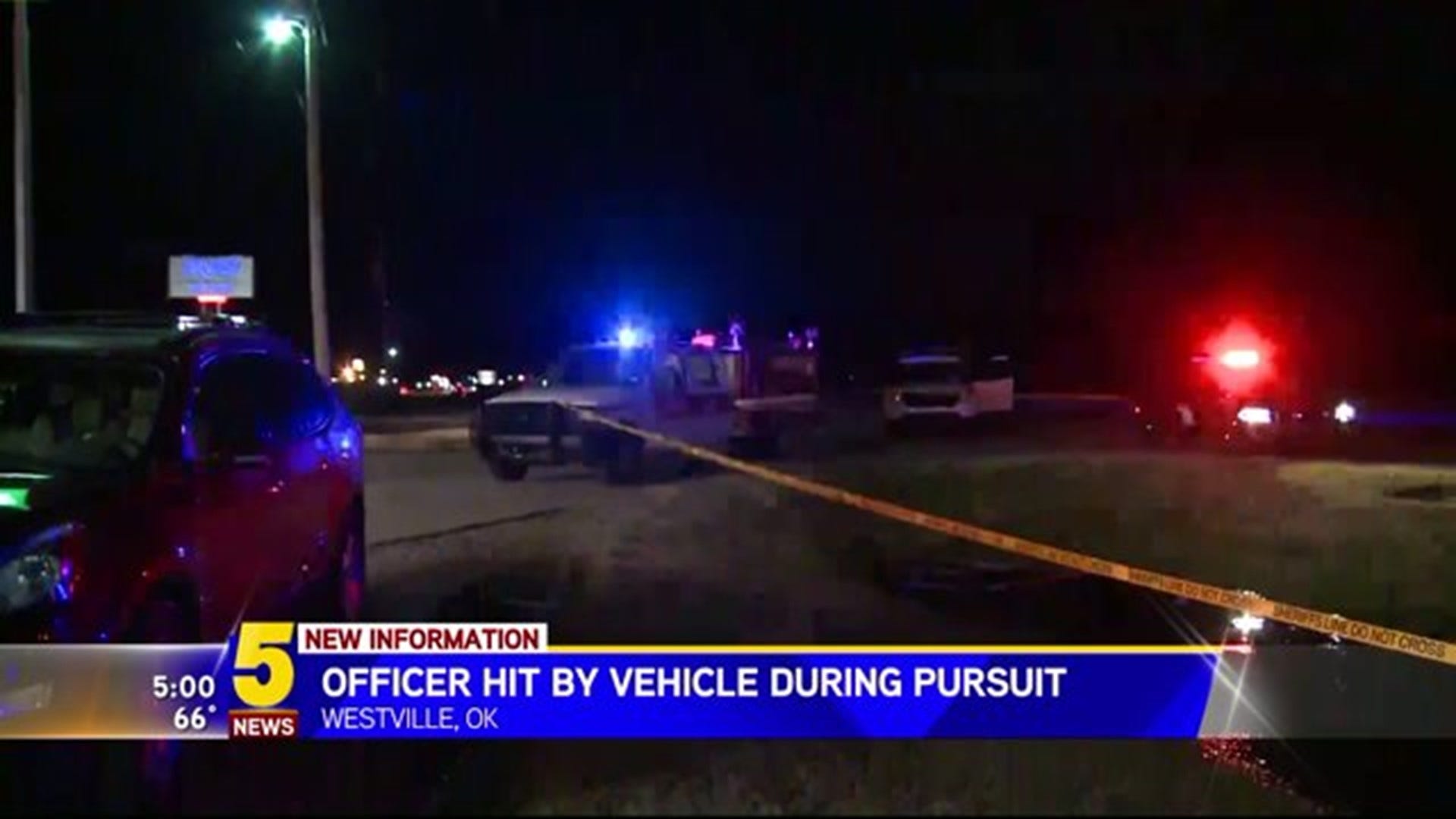
That unit belonged to Officer Josh Sidebottom. Josh was standing outside it with his shotgun. According to Adair County District Court records, Case No. CF-2015-256, Rowan veered toward the back of the unit where Josh had moved. He struck Josh at a speed of over 80 miles per hour.
He did not stop. He hit a police officer with his car at more than 40 miles per hour over the posted limit and kept driving.
He left Josh Sidebottom on the side of Highway 59 in Westville, Oklahoma.
That night, I had to leave my children asleep in their beds, not knowing whether their father was still alive.
Brandon Rowan is the brother-in-law of Markwayne Mullin, the Oklahoma Republican who is waiting on a Senate confirmation vote to become Secretary of Homeland Security. A spokesperson for Mullin did not respond to a request for comment by publication time.
Josh was life-flighted to Washington Regional Medical Center in Fayetteville, Arkansas. Doctors performed a full body scan to determine the extent of his injuries. He had to endure it awake and in unimaginable pain because his blood pressure was too low to allow pain medication without risking that he would stop breathing.
The scan revealed: a broken left femur, broken left tibia, broken left fibula, broken right ankle, broken right arm, shattered right wrist and hand, a pelvis broken in four places, a broken and dislocated right shoulder, one kidney destroyed on impact, and extensive road rash, cuts, and bruising. He went into surgery around 5 a.m. the next morning, Dec. 15.
Later that same morning, I walked outside the front entrance of the hospital with our children to get a breath of fresh air. As we walked out, Markwayne, his wife Christie, and other members of their family walked out right behind us.
Not one word was spoken.
The father of my children was inside that hospital fighting for his life after nearly being killed by a member of their immediate family. I know they were there for their own family member who had also been admitted, and on some level I understand that.
But it stunned me. We were all from the same county. Our children attended the same school. He couldn’t offer even a word.
In the first 24 hours, Josh received more than 50 bags of blood, according to doctors treating him. A feeding tube was placed. He was put into a medically induced coma with a breathing tube for the first 14 days. After that, doctors performed a tracheotomy before infection set in from the tube being in his throat too long.
Surgeries were performed on the lower portion of his left leg, placing both internal and external fixators. Additional surgeries followed on his right arm, wrist, and ankle.
For eight hours every day, he was connected to a dialysis machine in hopes that his remaining kidney would begin working again.
He developed compartment syndrome in his left leg from the femur break. Doctors performed a bedside fasciotomy on his thigh and placed a wound vac to remove infected and dead tissue. Over the next six weeks, he was taken back to the operating room numerous times for wound care.
Josh’s dad, Rick, and I took turns sleeping in the chair beside his bed. Rick often slept in the waiting room because he didn’t want to leave in case Josh opened his eyes. Josh’s mother stayed in a hotel down the road. His sisters spent as much time there as they could, unsure whether the brother who used to annoy them as kids would ever walk out of that hospital.
Their nephew had been born only weeks before. Josh hadn’t met him yet.
During those six weeks, my mother and my immediate family stepped in to raise our children.
There was no Christmas at home with mom and dad. No sparkling grape juice on New Year’s Eve. No afternoon couch snuggles. No picking flowers outside as the sun went down.
Our lives were completely upended.
At the end of January, Josh finally woke up. He was moved to a rehabilitation center across the road from the hospital, where he stayed two weeks before coming home.
When he came home, he still had a wound vac attached to his leg. Home health nurses visited regularly, along with physical and occupational therapists. There were constant doctor appointments.
He was taking the equivalent of nearly 200 milligrams of morphine a day spread across three or four medications. Most of the time they barely touched the pain.
Our daughter didn’t recognize him at first. It took weeks before she would sit on his lap.
He couldn’t bear weight on his leg. He couldn’t get out of bed to go to the bathroom. He was bedridden for months.
By May of 2016, the pain had become unbearable. After a second opinion, Josh faced a choice no one should have to make: continue living in excruciating pain for years, or amputate.
The bone graft placed during the December surgery had failed because he had been unable to bear weight long enough for the bone to fuse.
In May 2016, Josh made the decision to amputate his left leg above the knee. Doctors removed it five inches above the knee because of the location of the original break, something his surgeons described as extremely rare.
While he was in the hospital for that surgery, his grandfather, a man he was incredibly close to, passed away. He couldn’t attend the funeral.
Our oldest son had to help me in ways that no six-year-old should ever have to. Even now, we still struggle with that. He didn’t get to just be a kid anymore. None of our children did.
The people of Adair County showed us incredible kindness during that time. GoFundMe campaigns were started. A large benefit was organized. Children at the school drew cards for Josh. Police departments and sheriff’s offices from surrounding counties in both Oklahoma and Arkansas supported us in more ways than I could ever list.
Rowan was convicted Aug. 29, 2017, in Adair County District Court, Case No. CF-2015-256, before Judge J. Jeffrey Payton. He received five years with the Department of Corrections on the lead count, with the balance of his sentence suspended. A motion to revoke that suspended sentence was filed March 12, 2025. A bench warrant was issued the same day and returned served March 13, 2025.
In 2016, I saw Markwayne and Christie a handful of times. Neither of them ever spoke to us. To my knowledge, Brandon Rowan’s family never reached out to anyone in ours.
December will be 11 years.
Josh and I have been divorced for the past five years, but what happened to our family is something we endured together. It is something he still fights through every single day. The woman he is spending his life with, her daughter, and their son will also carry any future complications that arise from Brandon’s choices that night.
I have never held Markwayne Mullin responsible for someone else’s actions. I simply cannot understand why someone so prominent, someone from the same county, the same community, would not extend even a small measure of empathy to a police officer nearly killed by his brother-in-law.
Much like the insertion of legislative language targeting the United Keetoowah Band of Cherokee Indians, support for measures such as the Lumbee Fairness Act, or his public defense of federal immigration enforcement following the fatal shooting of 37-year-old Renee Good while she sat in her vehicle in Minneapolis on Jan. 7, 2026 — it often feels as though issues that do not directly affect him or his family fail to receive his attention or concern.
In my view, anyone who holds a position of power should possess a genuine sense of empathy. Leadership is not simply about policy or influence. It is about people. It is about understanding the weight of decisions and the human cost behind headlines and legislation. Those elected to serve should remain mindful of the communities that shaped them, the constituents who placed their trust in them, and the men and women who continue to protect those same small towns they once called home.
My children almost lost their father that night.
But what they did lose was so much of their childhood.
They are who I am most angry for.