

Four tribes challenge gaming compacts in D.C. federal court; Stitt and Interior seek dismissal
By Troy Littledeer for Giduwa Cherokee News

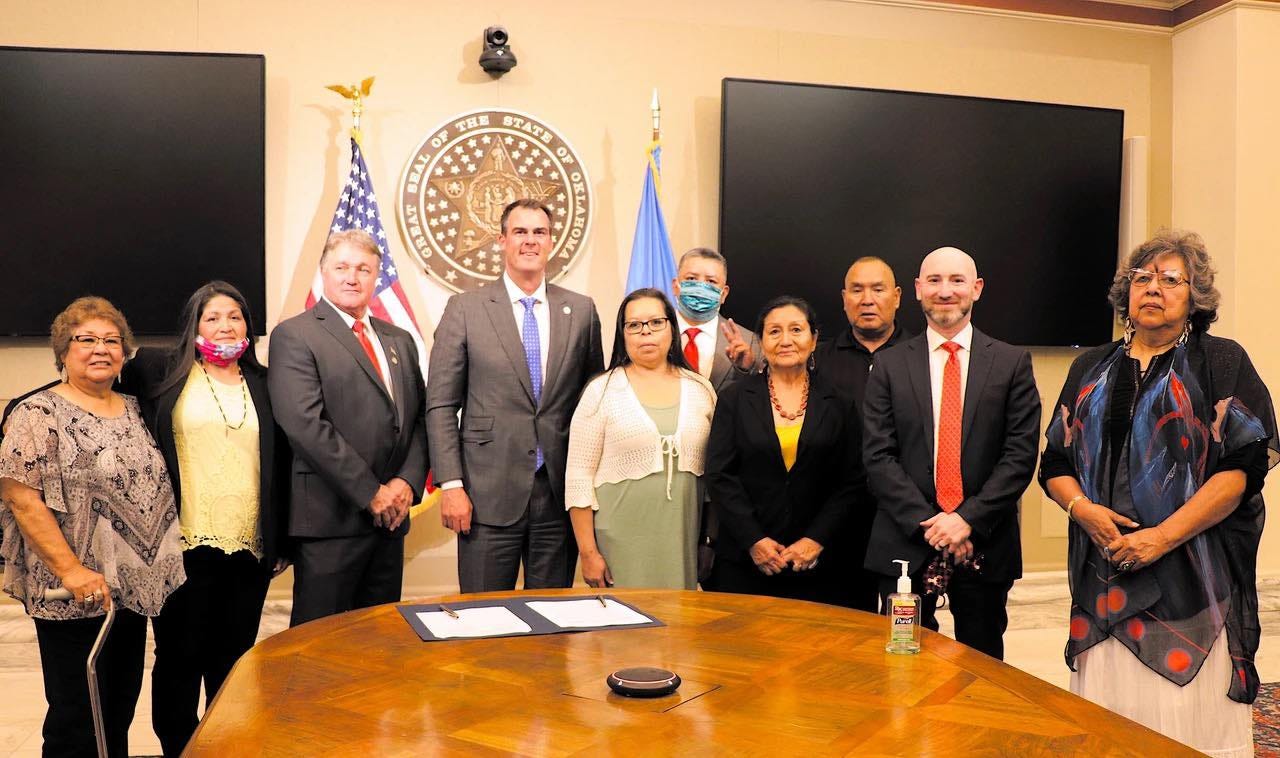
Gov. Kevin Stitt and the U.S. Department of the Interior are asking a federal judge in Washington to deny summary judgment to four Oklahoma tribes challenging gaming compacts Stitt signed with two other tribes, arguing the tribes misread the Indian Gaming Regulatory Act, 25 U.S.C. §§ 2701–2721, and failed to establish an injury in fact.
Stitt and Interior filed separate briefs opposing a motion for summary judgment brought by the Cherokee Nation, Chickasaw Nation, Choctaw Nation of Oklahoma and Citizen Potawatomi Nation. The case has been pending in the U.S. District Court for the District of Columbia since 2020.
The four tribes are seeking to invalidate gaming compacts Stitt signed with the Comanche Nation and Otoe-Missouria Tribe. They argue Stitt lacked authority to execute the agreements without Oklahoma Legislature approval under the State-Tribal Gaming Act. They also argue the Interior Department was obligated to reject the compacts rather than allow them to take effect through IGRA’s 45-day deemed-approval mechanism.
In his brief, Stitt argues IGRA does not require Interior to examine whether a governor complied with state law when entering a compact. He contends federal review is limited to whether a compact meets federal requirements, and that the tribes are asking courts to impose a condition Congress never wrote into the statute.
The Interior Department has taken the same position in prior and current filings. Federal lawyers argue the agency did not act arbitrarily or capriciously when the compacts took effect and that the agreements met all applicable federal requirements. Interior has further argued the question of Stitt’s authority under Oklahoma law falls outside the scope of federal IGRA review.
The federal government also contends the case should be dismissed on standing grounds. Interior argues the plaintiff tribes have not produced concrete evidence of economic harm. The agency characterizes the tribes’ injury claims as speculative, noting that the Comanche Nation and Otoe-Missouria Tribe had not yet operationalized the favorable compact terms in ways that produced measurable competitive effects. Without an injury in fact, federal lawyers argue the tribes lack standing under Article III.
Oklahoma Attorney General Gentner Drummond has supported the tribes’ position. Drummond backs the tribes’ summary judgment motion and maintains that Interior’s deemed approval of the compacts did not cure the underlying defect in Stitt’s authority to sign them.
The lawsuit originally included challenges to compacts with the United Keetoowah Band of Cherokee Indians and Kialegee Tribal Town. Those claims were severed from this litigation by court order in 2022.
The remaining dispute centers on whether the Comanche and Otoe-Missouria compacts create an unlawful competitive advantage. The plaintiff tribes argue the agreements allow those nations to pay lower exclusivity fees to the state, and that the lower fees could allow those tribes to offer larger jackpots and improved amenities — conditions the plaintiff tribes say they cannot match under their existing model compacts. Stitt counters that IGRA expressly permits tribes and states to negotiate different compact terms and that no statutory requirement mandates uniform agreements.
The court has not issued a ruling.
Troy Littledeer is a member of the United Keetoowah Band of Cherokee Indians and an award-winning journalist and photographer based in Adair County, Oklahoma. His reporting focuses on tribal sovereignty, federal Indian law, and accountability in Adair County and across Indian Country, with an emphasis on people over government and service to community members. He is a lifetime member of the Indigenous Journalists Association and recipient of the 2025 Tim Giago Free Press Award. Littledeer also supports high school and NCAA sports, as well as music and the arts.