

Cherokee Nation’s Taleyah Jones plays for joy, family and a promise to return home
By Troy Littledeer | @candyminksprings


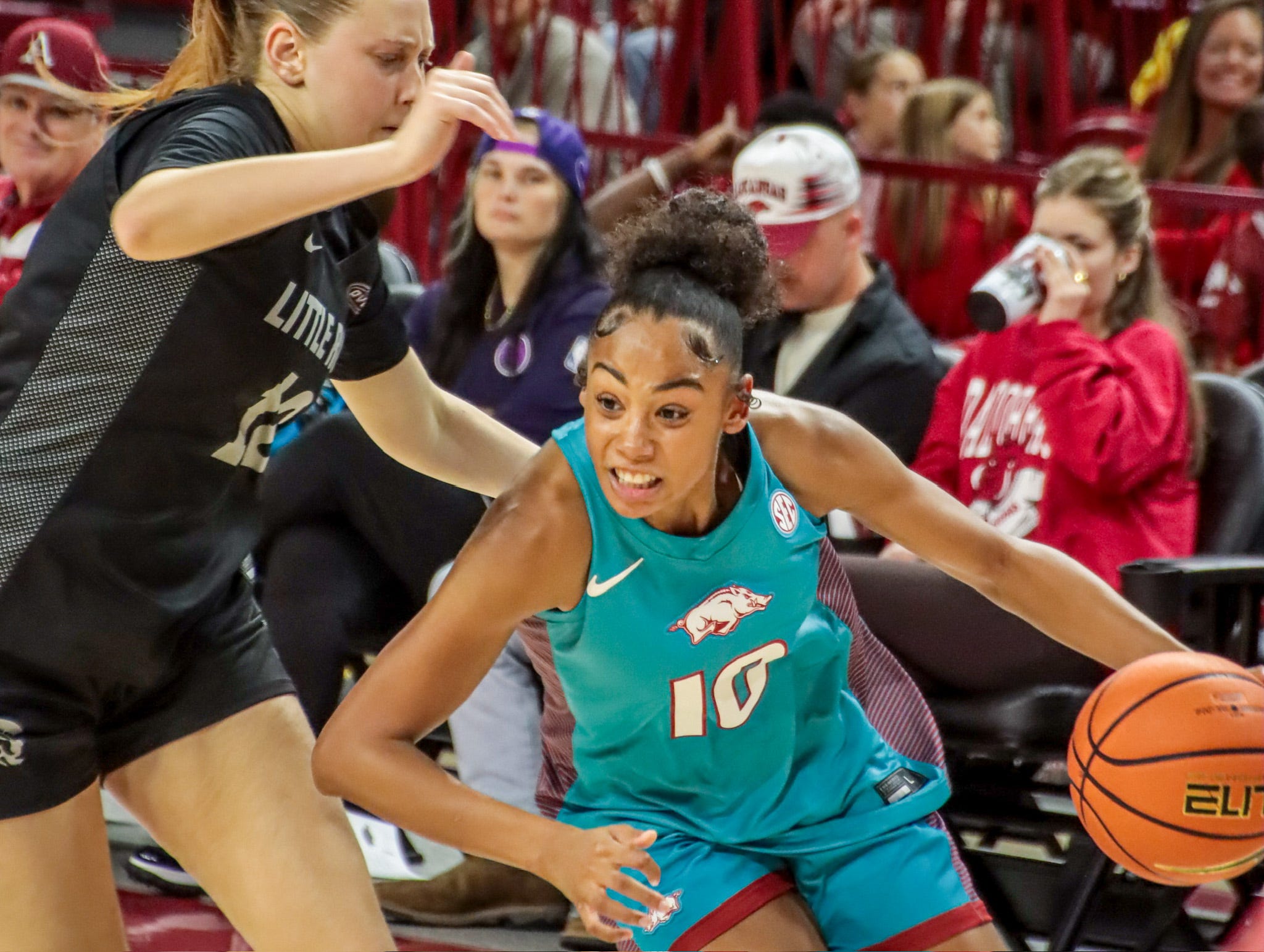
Stanley Jones has been watching his granddaughter play basketball since she was small enough to get lost in a crowd. He coached her through a co-ed youth league in Oklahoma where the girls were outscoring the boys by margins that made officials nervous. By the second season, the mercy rules came out. No full-court press. The girls were too good.
“The girls were better than the boys,” Stanley said. “You haven’t seen the best yet.”
He was right then. He is still right.
Taleyah Jones is a senior guard at the University of Arkansas, a Cherokee Nation citizen finishing her collegiate career in the Southeastern Conference. On November 20 at Bud Walton Arena, she scored 19 points on 8-of-11 shooting, connected on 3 of 4 attempts from three-point range, grabbed seven rebounds, and turned the ball over once in 28 minutes. Arkansas beat Little Rock 96-57.
Stanley’s fingerprints are on all of it — the competitiveness, the roots, the sense of where this is all headed when the final buzzer sounds.
He traces the family line to the Cooweescoowee District, one of the former districts of the Cherokee Nation, which he said is still recognized by the United Keetoowah Band. The line runs through his grandmother, Betsy Rogers, born in 1884, who spoke fluent Cherokee. Stanley tells a story about a photograph from Claremore — Will Rogers roping in a corral, a young girl on the fence watching. The family says that girl was Betsy.
When Taleyah graduated from Oral Roberts University a year ahead of schedule, with honors, Stanley had one thing to say about the ceremony.
“I told her, ‘You need to go get your Cherokee stole,’” he said. “Represent who you are.”
She has carried that instruction into every gym since.
Taleyah followed Head Coach Kelsi Musick from Oral Roberts to Fayetteville when Musick took the Arkansas job. She didn’t frame it as a strategic move. She framed it as a choice to be happy.
“I think it was just the relationship that we built at our previous school,” Jones said.
“Seeing her so happy made me feel like, ‘Okay, maybe I can be happy and enjoy my last year of basketball.”
That happiness produces havoc on defense. Jones reads passing lanes, forces deflections, and applies pressure at a pace that taxes her body every night. Stamina has defined her season. She logged 41 minutes in an overtime win against Central Arkansas, holding the defense together when the offense went quiet. She scored 21 against Texas Tech when her shot came back.
The Jones family occupies the seats directly behind the Arkansas bench at Bud Walton. Close enough for her grandmother to pick out Taleyah’s voice in the noise.
Among the family is an Osage cousin and aunt who are two-time National Indian Taco Champions. In Indian Country, that carries weight.
During a Nike N7 game at Oral Roberts — the brand’s initiative for Indigenous youth in sport — an Osage family approached her in the crowd. They weren’t there for a photo. They wanted to acknowledge her. Other families came too.
“I had a few young girls and a few parents come up to me and ask my heritage,” Jones said. “They were just so pleased and excited for me to be able to represent some form of Native American heritage.”
She understood what the moment meant.
“[We] are a foundation of this land,” Jones said. “It’s so important for us to have that recognition on what we have accomplished here… and just be able to flourish here in America.”
Jones is finishing prerequisites for occupational therapy. She intends to bring what she earned in the SEC back to the Cherokee Nation health system in Tahlequah. Stanley has made his position clear on this point.
“I have thrown that at her a thousand times,” he said. “Take your degree and go back to the Nation.”
She intends to.
“I’m a Native girl who can be able to play college basketball,” Jones said. “We’re here.”
Troy Littledeer is a writer and photographer based in Northeastern Oklahoma. He is a member of the United Keetoowah Band of Cherokee Indians and reports on tribal governance, education, and public accountability across Indian Country and surrounding communities. His work centers primary documents and recorded statements, with a focus on tribal law and the public record. Troy is a lifetime member of the Indigenous Journalist Association.
 | A guest post by
|
 | A guest post by
|