

A Kituwah Punk Commentary: Who Decides Who Votes
The United Keetoowah Band of Cherokee Indians passed an ordinance in December. The Constitution says something different. Nobody asked the membership.


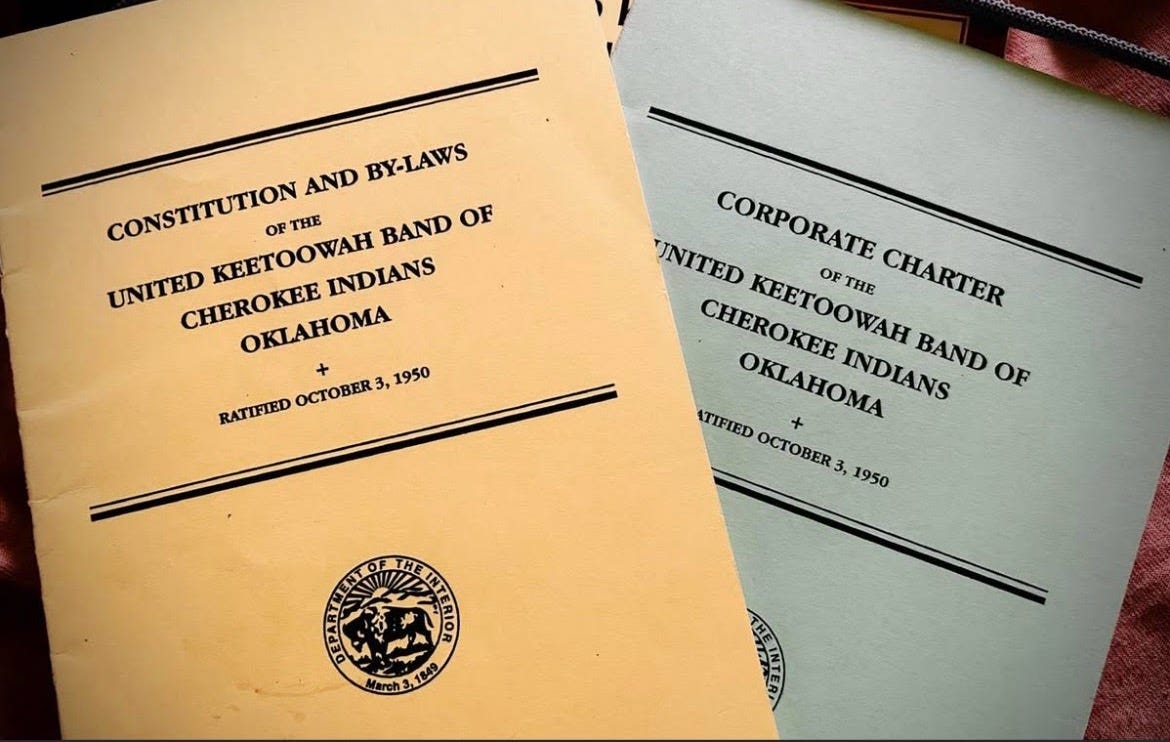
The United Keetoowah Band of Cherokee Indians in Oklahoma is a federally recognized tribe based in Tahlequah, Oklahoma. It has a Constitution. That Constitution says who can vote. Member, twenty-one years old, show up. That’s it. Ratified by the membership in 1950. Clear as spring water.
Then the Council passed an ordinance in December.
Now it’s five requirements where the Constitution requires two. Six months of exclusive membership — meaning you can prove at least one-quarter Cherokee blood and you’re not enrolled in any other tribe. Six months of residency in or affiliation with one of the nine electoral districts the tribe uses across northeastern Oklahoma. Your name on an approved voter list. Plus the original two. Which apparently nobody on the Council was counting when they compared this to the document the members actually ratified.
The Constitution gives the Council authority to regulate elections. So does the Corporate Charter. The Corporate Charter isn’t a business document — it’s a second foundational governing instrument issued to the tribe by the federal government in 1950 under the Oklahoma Indian Welfare Act, giving the Band legal standing to operate as a corporate entity. The membership ratified both documents on the same day, October 3, 1950. Both carry governing authority. Nobody’s disputing that the Council can run an election.
The question is whether running an election includes deciding who gets to be in it.
Because there’s another section in that same Corporate Charter — sitting right there, same document, same ratification date — that says membership, officers, and management of the Band shall be as provided in the Constitution and bylaws.
Not as provided by the Council in December. As provided in the Constitution.
The Constitution also has an amendment process. Article XII. Majority Council vote, approval by the Secretary of the Interior — the federal cabinet official who sits above tribal governments in the federal approval chain for constitutional changes — membership referendum, thirty percent participation floor. A real process that exists for exactly this kind of change.
Nobody used it.
What the Council produced instead was a resolution. Approved December 6, 2025. Resolution 25-UKB-132. Done before Christmas.
Now let’s talk about running for office, because it gets better.
The 1950 Constitution says a candidate for Chief needs to be thirty-five, live within the nine-district territory in northeastern Oklahoma that the tribe uses as its electoral map, and be a UKB member. Three things. Also clear.
The 2025 Ordinance says a candidate for Chief also needs five years of exclusive membership, twelve months of residency before filing, a valid driver’s license, and a high school diploma.
And the ordinance bars anyone who has previously served as an elected official of another federally recognized tribe.
None of that is in the Constitution the members ratified. Not one word of it.
Supporters of the ordinance will tell you this is about integrity. Meaningful community ties. Election security. And maybe some of those requirements make sense as policy.
But good ideas still need to go through the process. Especially when the process is written into the same document they’re working around. Especially when the change determines who gets a ballot and who doesn’t.
Here’s what that looks like on the ground.
You enrolled in the UKB in the last six months. The ordinance says you can’t vote. The Constitution says you can.
You served on a council for another tribe. The ordinance may bar you from running for UKB office. The Constitution doesn’t say that.
You don’t have a driver’s license. Maybe you never needed one. Maybe you couldn’t afford one. The ordinance says you can’t run for Chief. The Constitution doesn’t say that.
No UKB court has resolved which document controls. That question is still open.
The same Council that passed an ordinance adding five new requirements for voting and running for office hasn’t answered a public question about whether one of its own members meets the requirements already in the law. On January 3rd, UKB Treasurer Sonja Gourd raised the question publicly during a livestreamed Council meeting: whether Illinois District Representative Janelle Adair lives in the district she represents. Under Article II, Section 4 of the UKB Bylaws, a representative who moves out of their district forfeits the office automatically. The Election Ordinance requires that at least two Election Commission members visit every candidate’s residence to confirm residency before an election. Nobody produced a documented result. Nobody answered.
None of this is happening in a vacuum.
Across the United States, voting districts are being redrawn, consolidated, and eliminated — and the people who lose access first are almost always the same people. Native voters know this story by heart. In North Dakota, the Spirit Lake Nation and the Turtle Mountain Band of Chippewa Indians spent years in federal court fighting a legislative map that advocates said diluted their voting power. The 8th U.S. Circuit Court of Appeals ruled that private parties — tribes, individual voters, advocacy groups — can’t sue to enforce the Voting Rights Act. That ruling conflicted with decades of case law. According to the Associated Press, the U.S. Supreme Court this week vacated that ruling in Turtle Mountain Band of Chippewa Indians v. Howe and sent the case back to the 8th Circuit for further proceedings.
That’s the national context in which the UKB Council added five requirements to vote and run for office without asking the membership.
COMMENTARY
Restricting access to the ballot in Indian Country isn’t a new idea. It’s a very old one. Which raises the question the documents don’t answer but the pattern does: when the supreme governing body of a tribe starts building the same gates that have always kept Native people out of the room, who exactly are they trying to keep out — and why?
The documents wrote that story. We just read them.
The UKB Constitution and Bylaws were ratified October 3, 1950. The Corporate Charter was ratified October 3, 1950. The Election Ordinance of 2025 was approved by Council resolution, December 6, 2025, Resolution 25-UKB-132. The Supreme Court vacated the 8th Circuit’s ruling in Turtle Mountain Band of Chippewa Indians v. Howe on May 18, 2026, according to the Associated Press.
By Troy Littledeer. Troy Littledeer is a Keetoowah Cherokee journalist and photographer, publisher of Giduwa Cherokee News and Kituwah Punk. He covers tribal governance, sovereignty, and community impact across Indian Country from Stilwell, Adair County, Oklahoma. He is a member of the United Keetoowah Band of Cherokee Indians in Oklahoma.
 | A guest post by
|